Concrete for Retaining Walls in Manatee & Sarasota County: Mix, Volume, and Delivery Tips
Retaining walls are one of the most practical structures in Southwest Florida. Whether you’re managing grade changes on a residential lot, protecting a driveway edge, stabilizing a slope along a pond or canal, or building a commercial site boundary, concrete retaining walls handle the job better than most alternatives when done right.
The catch: ordering concrete for a retaining wall is not the same as ordering for a slab or driveway. The mix requirements are different. The pour may happen in stages. And in Florida’s heat and humidity, timing matters more than most contractors expect.
This post breaks down what you actually need mix design, PSI, volume, and delivery logistics for retaining wall projects in Manatee and Sarasota County.
Why Retaining Walls Are So Common in This Area
Manatee and Sarasota County sit in a region where flat lots, drainage easements, canal lots, and sandy fill soil are the norm. That combination creates constant demand for retaining walls across:
- Residential lots with grade changes between neighboring properties
- Driveways that are cut into a slope or elevated above the street
- Backyard pond and canal banks
- Landscaping beds with significant elevation changes
- Commercial and industrial sites with loading dock grade transitions
- Subdivision infrastructure and road embankments
Most of these walls need more than CMU block or timber. Poured concrete retaining walls especially when reinforced offer durability, resistance to hydrostatic pressure, and longevity that other materials can’t match in Florida’s wet season.
What Concrete Mix to Use for a Retaining Wall
Minimum PSI for Retaining Walls
For most poured concrete retaining walls, 3,000 PSI is the floor. Many engineers and experienced contractors in Florida specify 3,500 to 4,000 PSI, especially for:
- Walls taller than 3 feet
- Walls adjacent to water (canals, ponds, retention areas)
- Walls subject to vehicle loading or surcharge
- Coastal or near-coastal locations where permeability matters
A higher PSI mix is denser, less permeable, and more resistant to the freeze-thaw cycles that don’t apply here but also to Florida’s wet/dry swings and root intrusion over time. The American Concrete Institute (ACI) publishes mix design guidelines for retaining structures that most structural engineers in Florida reference when specifying wall concrete.
What About the Footing?
The footing (also called the footer) is the continuous base poured below grade that the wall bears on. It typically requires the same PSI as the wall itself, sometimes higher if it’s carrying significant load. In Florida, footings for retaining walls are usually:
- Poured below the frost line (not a concern locally, but minimum depth for bearing in sandy soils still applies typically 12–18 inches below finish grade)
- Wider than the wall often 2–3x the wall thickness
- Reinforced with rebar in both the footing and the wall, tied together before the pour
Many contractors pour the footing as a separate pour, let it cure, then form and pour the wall on top. That means two concrete orders, sometimes days apart. Volumetric delivery handles that well you order exactly what you need for each pour with no leftover.
Slump and Mix Workability
For a formed retaining wall, you want a slump in the 4–5 inch range workable enough to consolidate around rebar without being so wet it reduces strength. In Florida’s summer heat, concrete stiffens faster than it does in cooler climates, so mix timing and placement speed both matter.
If your wall has tight rebar spacing or complex form geometry, a 5-inch slump (or self-consolidating concrete, if your supplier offers it) helps avoid voids and honeycombing.
Footing Volume Example
A footing that is 18 inches wide, 12 inches deep, and 40 feet long: 1.5 ft × 1 ft × 40 ft = 60 cubic feet = ~2.2 cubic yards
For that same 40-foot wall at 4 feet tall, total concrete (footing + wall) comes to approximately 8 cubic yards well within the range where a short-load fee from a ready-mix plant applies. Read more about how those fees work in our post on Short Load Concrete in Manatee & Sarasota . With volumetric delivery, you pay only for what’s poured.
Always Add a Waste Factor
Add 5–10% to your volume estimate to account for form irregularities, ground settling, and spillage. For smaller pours, round up to the nearest quarter-yard rather than cutting it close.
Why Volumetric Delivery Works Well for Retaining Walls
Most retaining wall projects in Manatee and Sarasota County fall into a volume range where traditional ready-mix delivery becomes inconvenient or expensive:
- Short loads. Ready-mix plants charge significant short-load fees for orders under 7–10 yards. A wall footing is often 2–3 yards. A short section of wall might be 4–5 yards. You pay for the minimum load whether you use it or not.
- Staged pours. Retaining walls are often poured in two stages footing first, wall second. Ready-mix timing between stages is difficult to manage. Volumetric trucks mix on-site, so the second pour can be scheduled independently.
- Adjustable mix. If your wall design requires a different slump or PSI between the footing and the wall, a volumetric truck can adjust between pours without sending a new truck.
- No leftover concrete. You pay for what you pour. No wasted material, no disposal problem.
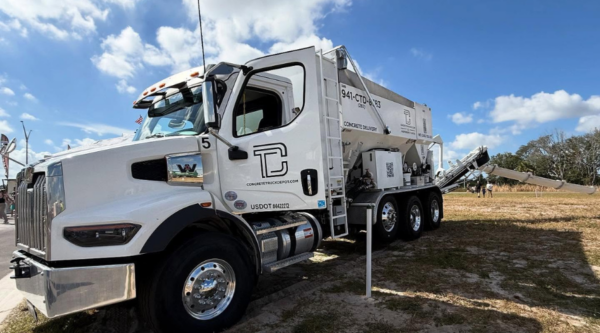
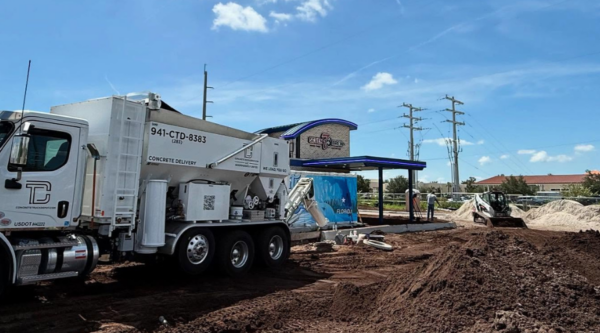
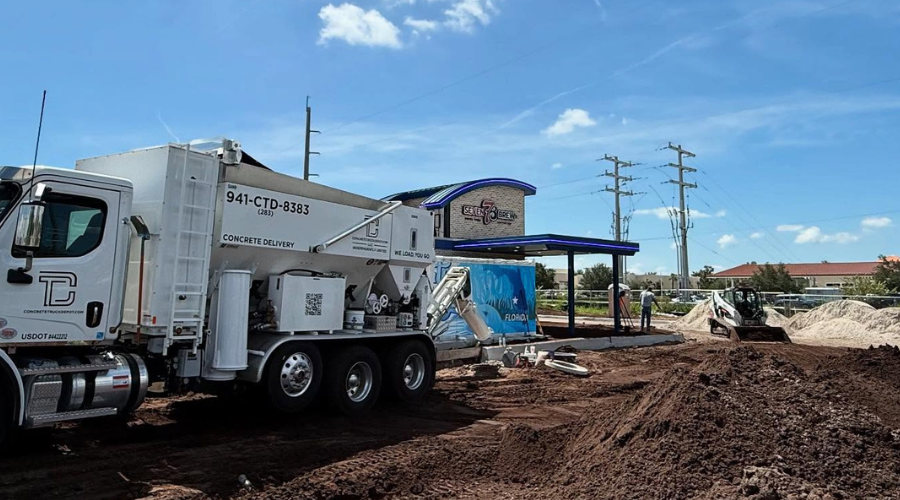
At Concrete Truck Depot, we deliver fresh concrete using a 2025 CemenTech volumetric mixer. Pricing starts at $190 for 10+ yards, and we charge in ¼-yard increments after the first yard so you’re never paying for concrete you didn’t use. Saturday and evening deliveries are available at custom pricing, which is useful for contractors who need to pour before or after peak heat hours.
Florida-Specific Considerations for Retaining Wall Pours
Heat and Cure Time
In Manatee and Sarasota County, summer concrete pours above 90°F accelerate hydration and can reduce workability before placement is complete. For retaining walls:
- Schedule early morning pours when possible (before 10 a.m.)
- Keep forms shaded if staging the day before the pour
- Have curing compound or wet burlap on hand for wall tops and exposed faces immediately after finishing
- Avoid adding extra water to the mix to compensate for stiffness, it reduces strength
Hydrostatic Pressure and Drainage
One of the most common retaining wall failures in Florida is hydrostatic pressure buildup water-saturated soil pushing against the wall from behind. Proper drainage behind the wall is as important as the concrete itself:
- Install drainage aggregate (such as #57 washed limestone) directly behind the wall
- Include weep holes or a perforated drain pipe at the base
- Backfill in lifts, not all at once
We stock #57 washed limestone by the ton at our Palmetto facility. Both pickup and delivery are available, so you can coordinate aggregate and concrete orders together.
Soil Conditions
Sandy soil and fill lots common in this region can shift under a footing if not properly compacted before the pour. Have your base compacted and inspected before forming. A footing poured on loose sand is a liability regardless of concrete quality.
What to Tell Your Concrete Supplier When You Order
When you call to schedule delivery, have this information ready:
- Project type: retaining wall footing, retaining wall, or both
- Dimensions: height, thickness, and length for each pour
- PSI required: minimum 3,000 PSI; confirm with your engineer if higher is specified
- Slump preference: typically 4–5 inches for formed walls
- Pour date and time: early morning preferred in summer
- Site access: width of access path for the truck, distance from the road to the pour location
- Reinforcement: steel rebar (confirm this with your concrete supplier it affects mix and consolidation approach)
If you have a two-stage pour (footing then wall), let us know upfront so we can schedule both deliveries with the right lead time.
Retaining Wall Applications We Deliver to Regularly
Our delivery area covers Manatee and Sarasota County, including:
- Palmetto, Ellenton, Parrish: residential lot grading, canal bank walls, driveway borders
- Bradenton and West Bradenton: commercial site walls, landscape retaining features
- Sarasota and Lakewood Ranch: residential and HOA-adjacent grade transitions
- Venice, Nokomis, Osprey: slope stabilization, driveway retaining, pool surround grade work
- North Port: new construction sites with significant grade changes
If you’re outside these areas or have a larger commercial project, contact us to discuss scheduling and logistics.
Ready to Order Concrete for Your Retaining Wall?
Whether you’re pouring a footing this week or planning a multi-stage wall project, we can help you get the right mix, the right volume, and a delivery time that works for your schedule.
Call or text us to discuss your project. Same-day delivery may be available; booking at least one week in advance is recommended for planned projects.
Concrete Truck DepotPalmetto, FL Serving Manatee, Sarasota, and Hillsborough Counties Office Hours: Monday–Friday, 8 a.m.–4 p.m. Loading Facility: Open 24 hours